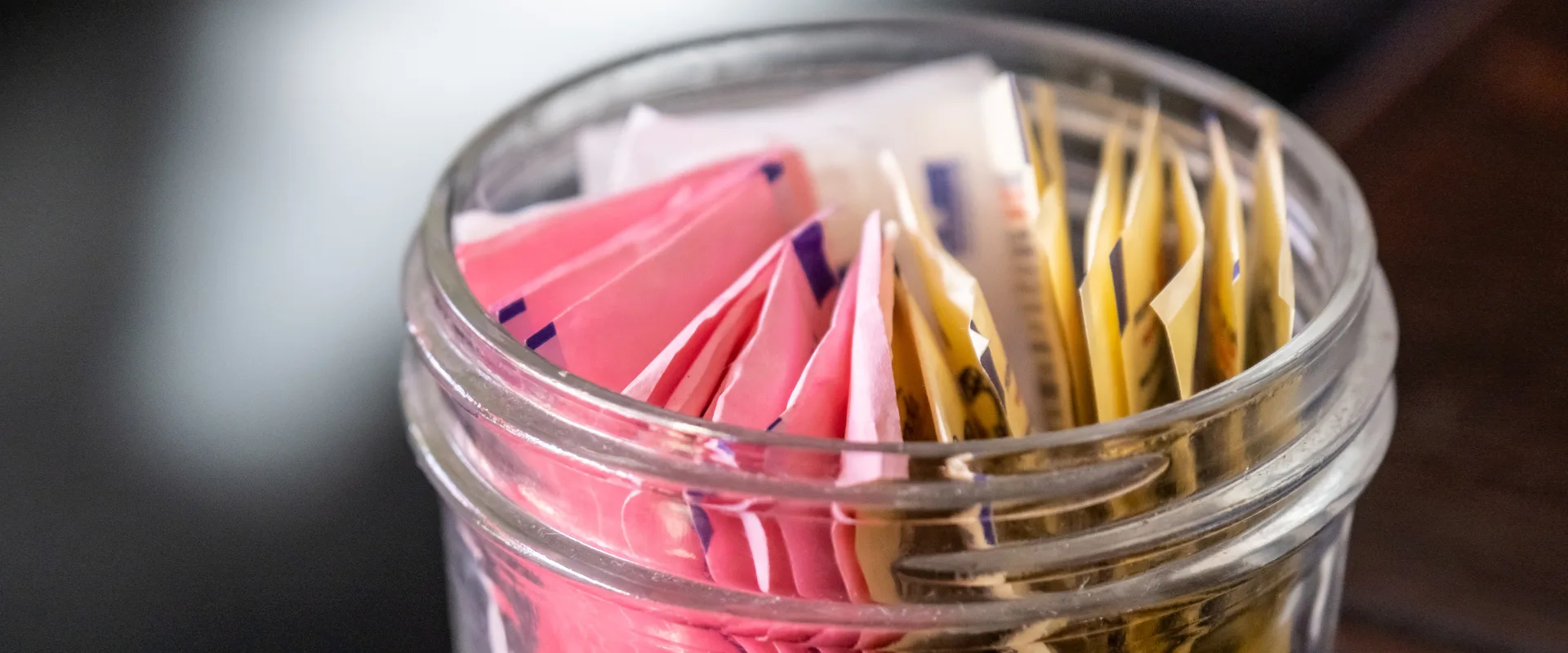
Artificial sweeteners are food additives that provide sweetness with little to no calories. They are widely used as a sugar substitute to reduce calorie intake, support weight management, and help control blood sugar levels.
Artificial sweeteners taste much sweeter than sugar, so only a very small amount is needed. They are commonly found in sugar-free drinks, candies, gums and some baked goods.[1][2]
What Are Artificial Sweeteners?
Artificial sweeteners (also called non-nutritive sweeteners) differ from regular sugar (a nutritive sweetener). Sugar provides energy and has properties that affect texture, browning and fermentation in cooking. Artificial sweeteners mainly add sweetness without these other effects, which is why they sometimes change the texture of baked goods.[1][2]
Types of Artificial Sweeteners Approved by the FDA
The following artificial sweeteners are approved by the U.S. Food and Drug Administration (FDA):[1][3]
1. Acesulfame-K
About 200 times sweeter than sugar. Heat-stable and suitable for baking. Common brands: Sunett® and Sweet One®.
2. Aspartame
160–220 times sweeter than sugar. Contains 4 kcal/g. Not suitable for high-heat baking. Brands: NutraSweet®, Equal®, Sugar Twin®. Not safe for people with phenylketonuria (PKU).
3. Neotame
7,000–13,000 times sweeter than sugar. Heat-stable and used in many foods. Brand: Newtame®.
4. Saccharin
300 times sweeter than sugar with zero calories. Heat-stable but can leave a metallic aftertaste. Brands: Sweet’N Low®, Sweet Twin®.
5. Sucralose
600 times sweeter than sugar. Widely used and heat-stable (suitable for baking). Brand: Splenda®.
6. Stevia
Derived from the Stevia rebaudiana plant. 200–400 times sweeter than sugar and considered nearly zero-calorie. Brands: Truvia®, PureVia®, Enliten®.
7. Luo Han Guo (Monk Fruit) Extract
100–250 times sweeter than sugar with zero calories. Brands: Nectresse®, Monk Fruit in the Raw®, PureLo®.
8. Advantame
20,000 times sweeter than sugar. Heat-stable and approved in 2014.
Are Artificial Sweeteners Safe?
According to the FDA, artificial sweeteners such as Acesulfame-K, Aspartame, Neotame, Saccharin, Sucralose and Advantame are approved food additives. Stevia and Luo Han Guo extract are classified as Generally Recognised as Safe (GRAS).[3][6]
Each sweetener has an Acceptable Daily Intake (ADI) — the amount that can be consumed daily over a lifetime without appreciable health risk:
| Sweetener | ADI (mg/kg body weight/day) |
|---|---|
| Acesulfame-K | 15 |
| Aspartame | 50 |
| Neotame | 0.3 |
| Saccharin | 15 |
| Sucralose | 5 |
| Advantame | 32.8 |
| Stevia | 4 |
| Luo Han Guo | Not determined |
Effects on Health
Appetite and Food Intake
Most studies show that artificial sweeteners do not increase appetite. The Academy of Nutrition and Dietetics concludes that aspartame, saccharin and sucralose do not affect appetite or food intake in a meaningful way.[1][8]
Energy Intake and Body Weight
Because most artificial sweeteners contain zero or very few calories, replacing sugar with them can reduce overall calorie intake. Research supports their use as part of a weight-loss or weight-maintenance plan.[1][9]
Diabetes
Artificial sweeteners can help people with diabetes enjoy sweet tastes without adding carbohydrates or calories. However, products containing them may still contain other sources of energy, so nutrition labels should always be checked.[1][10]
Cancer
Extensive research, including reviews by the National Cancer Institute, has found no clear evidence that artificial sweeteners cause cancer in humans when consumed within the Acceptable Daily Intake.[11][12]
Pregnancy
The FDA considers approved artificial sweeteners safe for pregnant and breastfeeding women when used within recommended limits.[1]
References
- Position of the Academy of Nutrition and Dietetics: Use of Nutritive and Nonnutritive Sweeteners. J Acad Nutr Diet. 2012.
- U.S. Department of Agriculture. Nutritive and Nonnutritive Sweetener Resources.
- U.S. Food and Drug Administration. Additional Information about High-Intensity Sweeteners Permitted for Use in Food in the United States.
- Chattopadhyay S, et al. Artificial Sweeteners – A Review. J Food Sci Technol. 2014.
- Ashwell M. Stevia, Nature’s Zero-Calorie Sustainable Sweetener. Nutr Today. 2015;50(3):129–134.
- U.S. Food and Drug Administration. Ingredients, Additives, GRAS & Packaging Guidance.
- EUFIC. What Is an Acceptable Daily Intake (ADI)? 2021.
- Lohner S, et al. Health Outcomes of Non-Nutritive Sweeteners. Nutr J. 2017;16(1).
- Pang M, et al. The Impact of Artificial Sweeteners on Body Weight Control and Glucose Homeostasis. Front Nutr. 2021.
- Chee W, et al. Medical Nutrition Therapy Guidelines for Type 2 Diabetes Mellitus. Malaysian Dietitians’ Association; 2013.
- Bernardo W, et al. Adverse Effects of the Consumption of Artificial Sweeteners – Systematic Review. Rev Assoc Med Bras. 2016.
- National Cancer Institute. Artificial Sweeteners and Cancer. 2016.